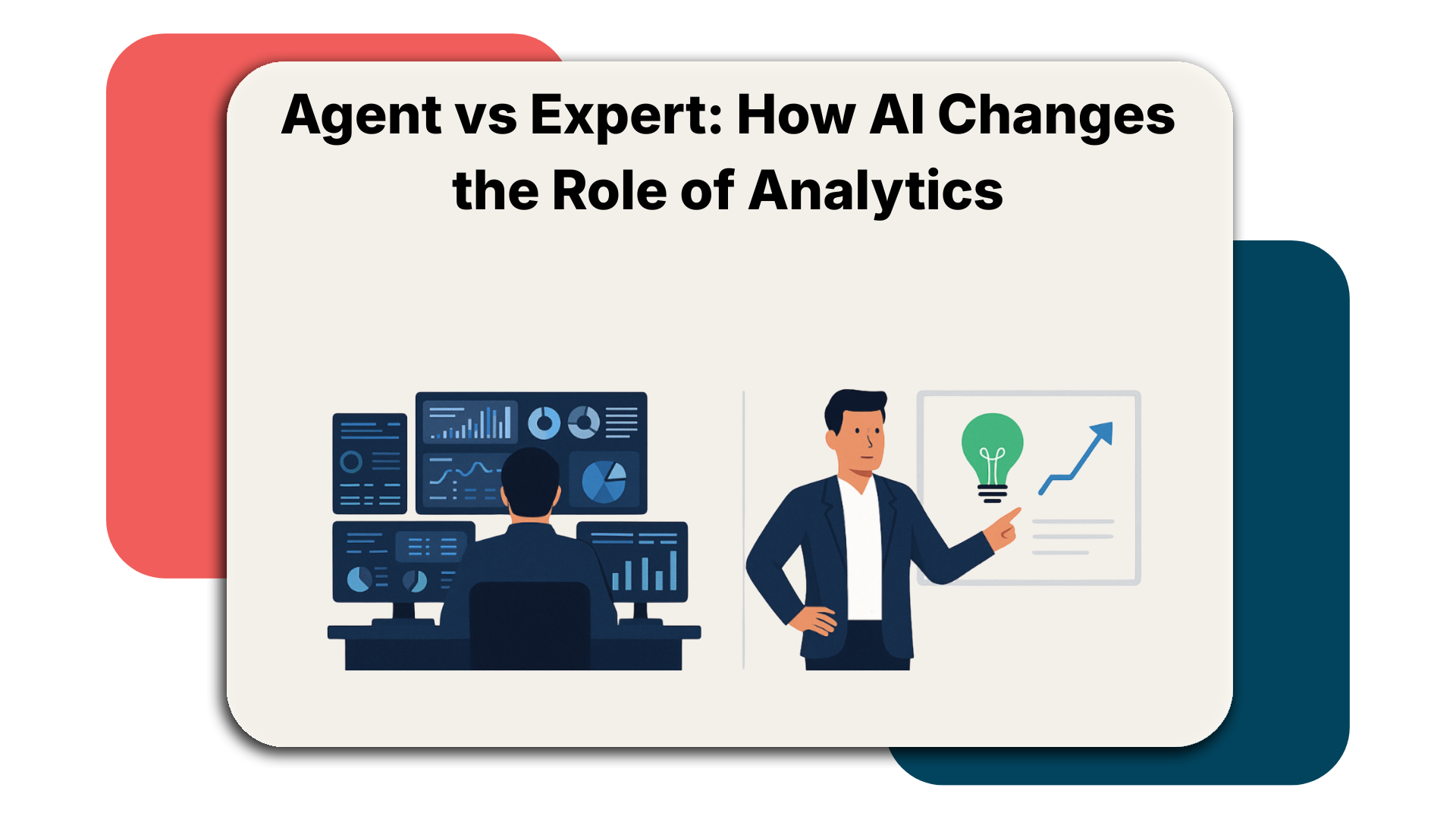
For most of the last decade, the person who understood the data was the person who owned the answer. Not because they were making every decision, but because everyone else depended on them to understand what was going on.
That made sense. Connecting signals across advertising, Buy Box, content, and traffic took time and experience. Interpretation was slow, so it concentrated in the hands of the few people who could do it reliably.
AI is changing that equation. Not by replacing judgment, but by making interpretation faster and more accessible, often surfacing a working explanation in seconds.
Which raises a question most teams haven't asked yet: if more people can now understand what’s happening, who is responsible for acting on it?
The Old Model Had a Clear Shape
 In a traditional analytics setup, roles were defined by access and ability. Analysts built the views. Performance managers read them. Decision makers waited for a recommendation. By the time action happened, the window had often narrowed.
This wasn't a failure of process. It was a rational response to the cost of interpretation. When connecting signals takes hours, you centralize that work in the people best equipped to do it.
What Changes When Interpretation Gets Cheaper
When AI can surface a working explanation early, the bottleneck shifts.
The question is no longer "who can figure out what happened." It's "who decides what to do about it."
That is a meaningfully different role. It requires judgment about trade-offs, appetite for acting on incomplete information, and clarity on what the business is actually optimizing for. Those are not analytical skills. They are decision skills.
As one senior Amazon seller put it:
"We had all the data we needed. What we didn't have was someone whose job it was to make the call."
The Risk No One Talks About
Faster interpretation without clearer ownership doesn't speed things up. It creates more confident confusion.
If everyone on a team can now access a working explanation but no one is clearly responsible for acting on it, you get a new version of the old problem. More signal, same delay.
The teams that benefit most from AI-assisted analytics are not the ones with the best tools. They are the ones who have decided, in advance, who the decision belongs to.
What This Means in Practice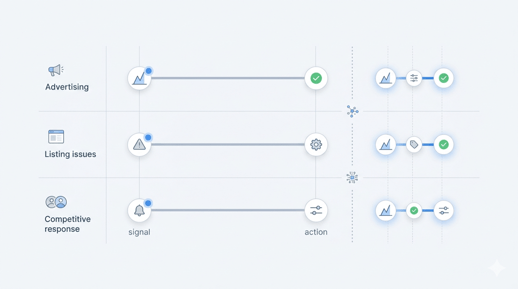
On Amazon, the gap between insight and action shows up in three places most often:
- Advertising adjustments. Connecting spend efficiency to conversion data before making a bid change used to require an analyst. That lag is shrinking. The real question now is whether the person managing bids has the authority to act, or whether they're still waiting for sign-off that moves slower than the auction.
- Listing issues. Content suppression, compliance flags, and traffic drops can now be connected faster. But faster connection only helps if someone is empowered to fix the listing without a meeting first.
- Competitive response. This is where the gap hurts most. Competitor behavior moves in hours. If interpretation takes two days and approval takes two more, the AI hasn't helped at all.
The Shift Is Structural, Not Personal
This isn't a critique of any particular role. It's a recognition that AI changes what each role is for.
Experts remain essential. But the value of expertise is moving away from "I can read the data" and toward "I know what the data should trigger, and I can make that call."
The teams that adapt fastest won't be the ones with the most sophisticated tools. They'll be the ones who redesign ownership to match the new speed of understanding.
That's the real opportunity. And most teams haven't taken it yet.
In the next post, we'll look at what this means for how emax builds AI into the workflow, not as a reporting layer, but as a decision support system designed to help the right person act at the right moment.