Analytics Is Changing Its Starting Point
For years, analytics has followed the same basic pattern.
You start by exploring. You open dashboards. You scan metrics. You filter, compare, and drill down.
Only after that process do you begin to understand what might be happening.
This way of working made sense when decisions were slower, data environments were simpler, and analysis could wait. But today, that starting point no longer holds up.
AI is changing analytics not by adding more data, but by changing where analysis begins.
From Exploration to Orientation
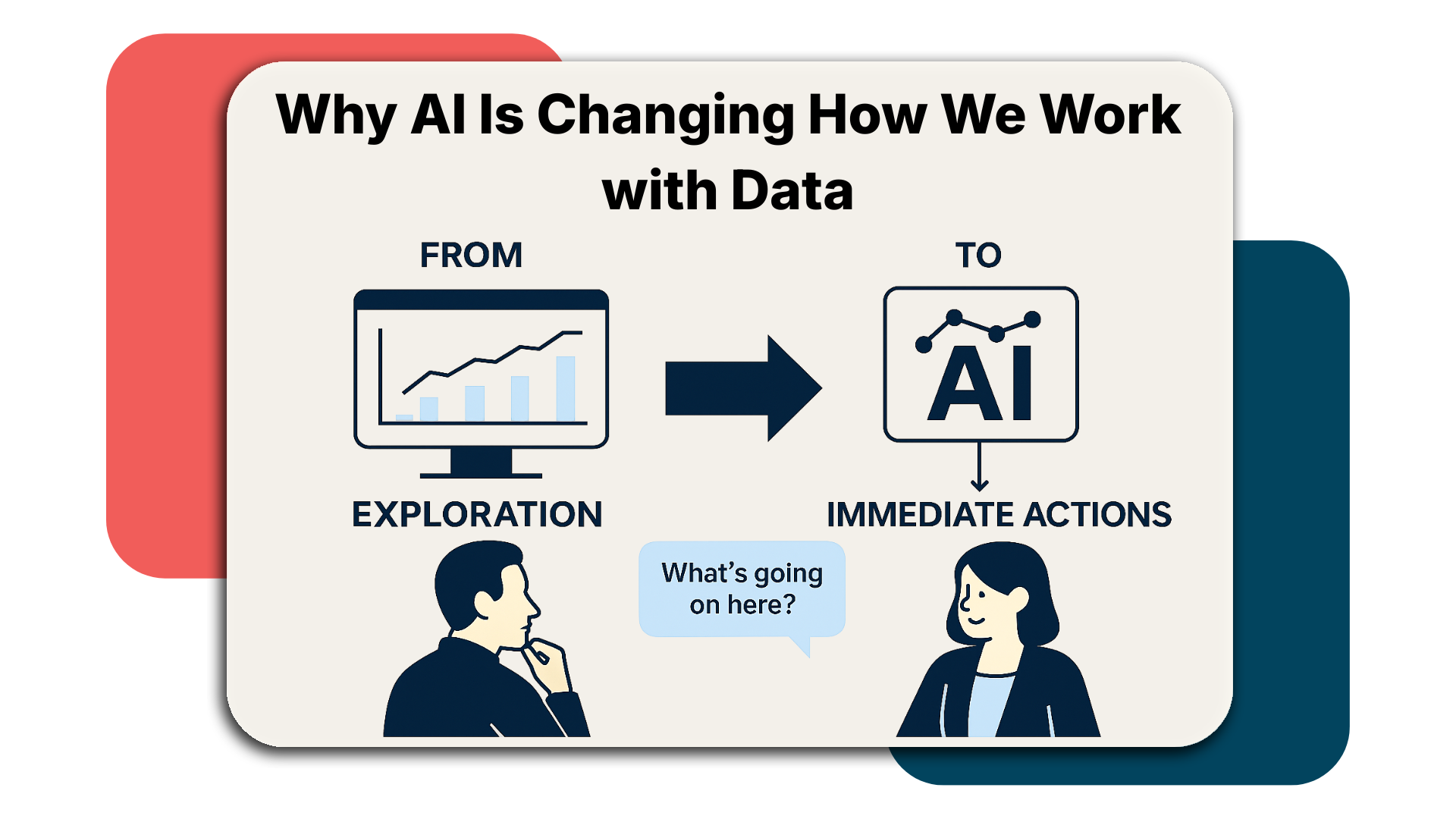
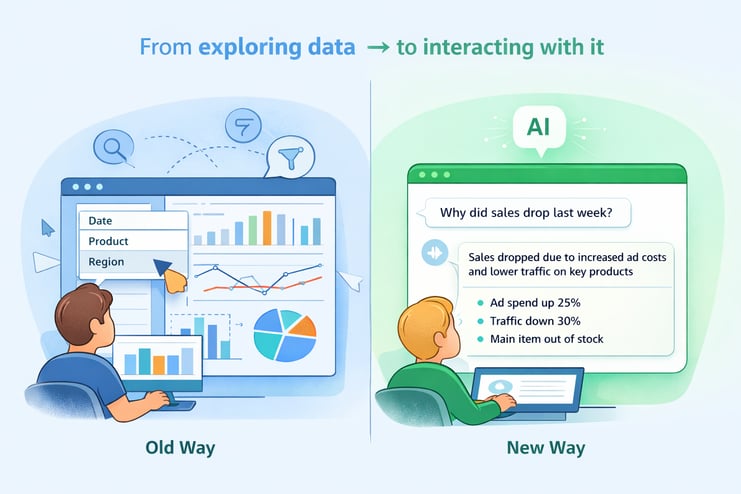
Traditional analytics starts with exploration. Teams move through charts and reports to build their own understanding, step by step.
The insight comes at the end of the process.
AI flips this around.
Instead of beginning with navigation, teams can begin with orientation. They start with a question, a signal, or a change that needs explanation. Interpretation is no longer the result of long exploration, it becomes the starting position.
Rather than asking, “Where should I look?”, teams begin with, “What’s going on here?”
Why This Matters in Complex Environments
As data environments grow more complex, the cost of starting from raw views increases.
Multiple signals often change at the same time. Performance shifts rarely have single causes. Context is spread across tools, dimensions, and timeframes.
In this situation, exploration alone becomes inefficient. By the time teams assemble enough context to feel confident, the moment to act may already be passing.
AI does not simplify the environment.
It simplifies how teams enter it.
Working From Interpretation, Not Toward It
This shift changes the role analytics plays in daily work.
In the old model, teams work toward an explanation.
In the new model, teams work from one.
Interpretation is still reviewed, questioned, and refined by humans. Judgment still matters. But the effort required to reach a meaningful understanding decreases dramatically.
The result is not automated decisions.
It’s faster alignment on what deserves attention.
What Changes in Practice
When interpretation is available earlier, analytics work looks different:
- Less time is spent preparing context.
- Fewer steps are required to connect signals.
- Discussions move faster from what happened to what should we do.
Analytics shifts from a supporting function to an active part of decision‑making, helping teams evaluate situations rather than assemble information from scratch.
A Shift, Not a Replacement
AI does not replace dashboards or existing analytics tools.
Dashboards remain essential. They provide visibility, consistency, and shared reference points.
AI builds on that foundation by addressing what dashboards are not designed to do: explain relationships, prioritize signals, and surface context across changes.
This is not a new reporting layer. It’s a new way of engaging with data.
Why This Is the Real Change
The real impact of AI in analytics is not speed alone.
It’s the reduction of distance between noticing that something has changed and understanding what that change means.
That distance is where decisions tend to slow down. That is where AI now makes a practical difference.
At emax digital, we see this shift as a change in how teams experience data. Moving from manual exploration to informed orientation.
Not by replacing existing tools. But by changing how work with data begins.