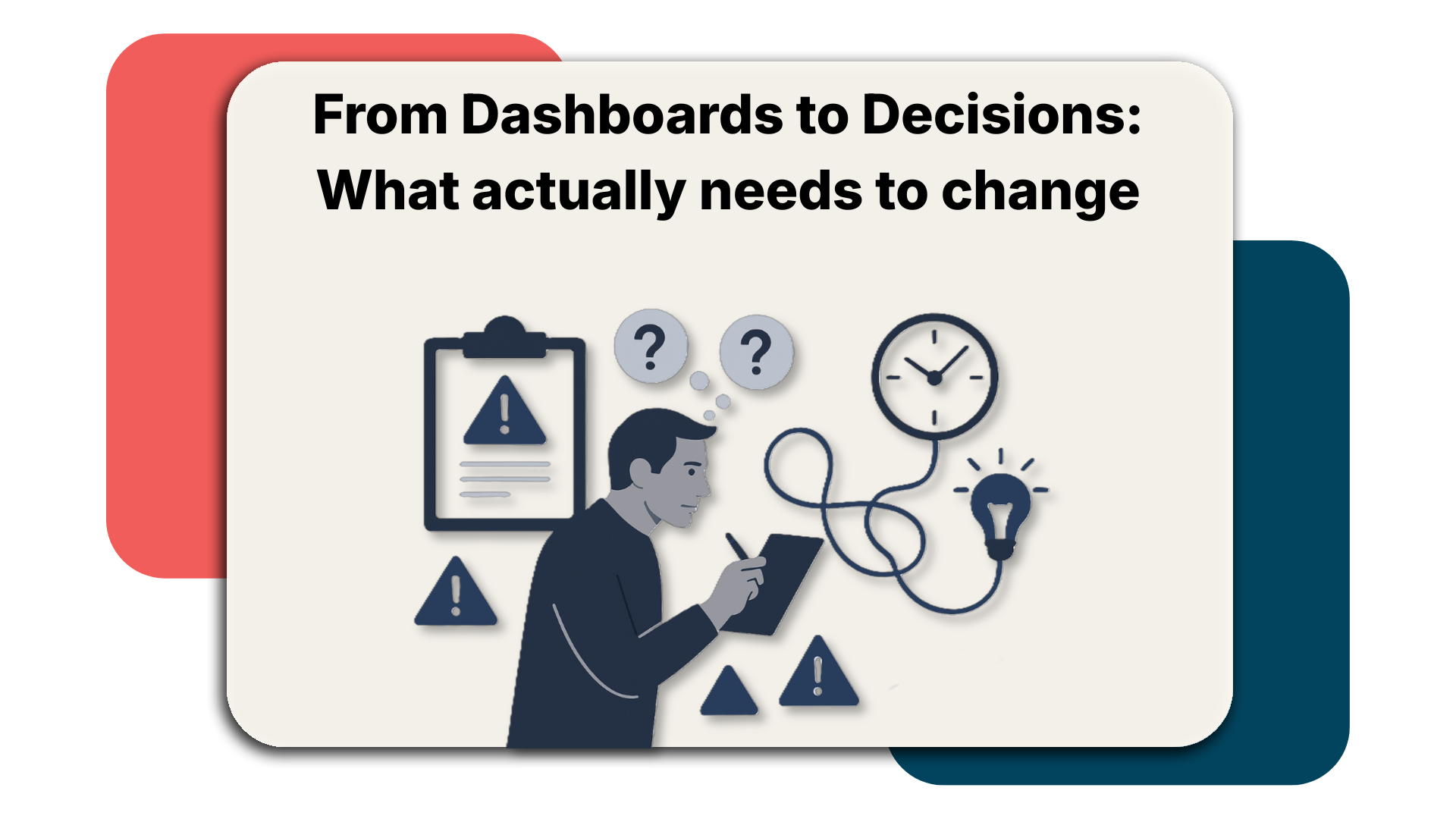
From Dashboards to Decisions: What actually needs to change
For most Amazon teams, the challenge is no longer understanding performance data. It is deciding how to respond when multiple signals shift at once.
Dashboards already do their job well. They surface changes, flag anomalies, and make performance visible. The problem usually appears after something changes, when teams need to align on what matters, choose a direction, and act quickly enough for it to make a difference.
That is where change is needed.
When Multiple Signals Shift, Direction Becomes Hard
On Amazon, a single performance change can usually be explained in more than one way.
A dip might be driven by advertising efficiency.
It might be Buy Box availability.
It might be traffic mix, content suppression, or competitor behavior.
All of these signals are often visible somewhere. The challenge is not access to information. It is deciding which signal should guide the next action.
When several explanations seem plausible at the same time, progress slows. Not because teams are unsure what happened, but because it is unclear what the change should trigger.
Decisions Do Not Fail Because Data Is Missing
They fail because ownership is unclear.
In many Amazon setups:
- analysts prepare views
- performance managers interpret them
- decision makers wait for confidence
- action happens late or cautiously
Responsibility is spread across too many steps, and no single step clearly owns the decision.
Decision focused analytics requires answering a few uncomfortable questions upfront:
- Who decides what this change means
- Who decides what happens next
- How quickly does that decision need to be made
If these answers are not clear, even excellent data leads to delay.
What Actually Needs to Change
Moving from dashboards to decisions does not require a new reporting stack. It requires a different way of working. Three shifts matter most.
1. Treat Performance Changes as Decision Moments
When something moves, the first question should not be: Which report explains this
It should be: What decision might this require
A bid adjustment
A listing fix
A budget reallocation
A competitive response
If no decision is identified early, analysis expands without direction. Teams dig deeper not because clarity is increasing, but because ownership is missing.
2. Shorten the Path to a Working Explanation
Amazon performance rarely has a single root cause.
Teams do not need perfect certainty before acting. They need a working explanation early. Something concrete enough to react to.
A working explanation can be wrong or incomplete. It can and should be refined. Without it, discussion stays abstract and action waits.
The real choice is often between acting early with an imperfect explanation, or acting late with a confident one.
Amazon environments usually reward the first.
3. Build Workflows Around Speed, Not Certainty
Amazon rewards timely correction more than perfect understanding.
Waiting until every signal aligns often means reacting after momentum is lost. Decision focused teams accept incomplete information, as long as the direction is reasonable and revisitable.
This does not reduce discipline.
It changes when teams commit.
Clear checkpoints, explicit owners, and fast feedback loops matter more than airtight explanations.
This Is a Behavioral Shift, Not a Technical One
The move from dashboards to decisions does not start with new tools.
It starts with changing how teams:
- frame performance changes
- assign decision responsibility
- move from signal to action
Dashboards remain the shared reference point.
Decisions become the center of gravity.
Why This Shift Is Now Realistic
Until recently, decision focused workflows were difficult to sustain.
Interpretation depended heavily on individual experience and manual effort. Connecting signals across advertising, Buy Box, content, and traffic took time, and speed suffered as a result.
What has changed is not the need for judgment, but the cost of reaching a working explanation. New technologies can surface context and relationships earlier, reducing the effort required before teams can focus on decisions.
This does not remove responsibility from people.
It makes timely decision making more achievable.
Why This Matters on Amazon
Amazon environments change faster than most analytics cycles.
Teams that reduce friction between seeing and choosing do not just react better. They compound advantage through faster correction.
The difference is not smarter data. It is clearer decision flow under uncertainty.
In the next post, we will look at one approach that promises to support this shift and is often misunderstood: conversational analytics.